
Who Owns Your Website? What Businesses Should Know Before Hiring a Web Designer
Most Orange County businesses hire a web design company based on design, cost, and timeline. They rarely stop to ask, “Who actually owns this?”
Ownership doesn’t seem like a big deal until you want to change providers, migrate the site, or end your contract. Before launching a new website, you should clearly understand what you own outright, what you’re licensing, and what your exit strategy looks like if you ever decide to switch agencies.
Start With the Basics
A website involves several separate components that are easy to confuse.
Your domain name is the address people use to find your website. Your website consists of the files, database, content, design, and functionality. Hosting is the service that provides the server where the website operates.
Email may also use your domain, but it is generally a separate service.
Owning the website does not necessarily mean you own or directly manage all of these components. The important point is understanding who controls each one and what happens if your relationship with your web company changes.
Your Business Should Own Its Domain
Your domain is one of the most important digital assets your business has.
The business should be listed as the registrant and owner of the domain. If you are purchasing a new domain, it is usually best to purchase it through an account controlled by your business. Your web company can help configure and manage it without owning it.
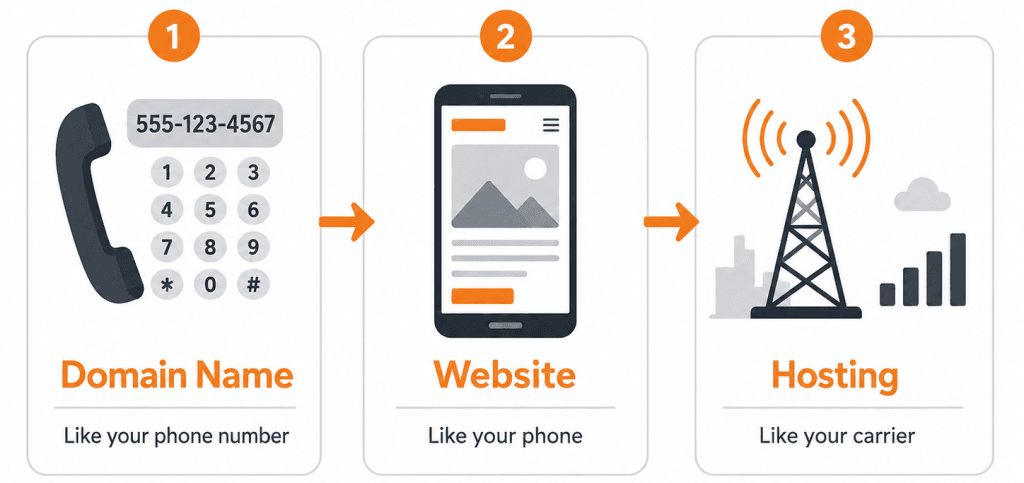
Think of your domain like your phone number, your website like your phone, and your hosting company like your wireless carrier. You can replace the phone or change carriers while keeping the same number. Your domain should work the same way. It should remain under your control even if you rebuild your website or change hosting companies.
Before hiring a web company, make sure you retain ownership of your own domain name.
Know Who Owns the Website
Your agreement should clearly explain website ownership.
For a custom website project, determine whether ownership transfers to your business and when that transfer occurs. In many cases, this happens after the project has been completed and paid for.
Also understand that not every component of a website is necessarily owned outright.
WordPress is open-source software, but websites often use third-party plugins, themes, fonts, stock photography, APIs, or other services that are licensed. Some licenses may be provided by the web company while you are a client and may need to be replaced if you move the website elsewhere.
Be Careful About Contract Lock-In
Long-term agreements are not automatically a problem. The issue is understanding what you are agreeing to and what you receive in return.
Pay particular attention when a contract requires a long commitment but the provider retains ownership or control of the website.
Ask:
- Do I ever own the completed website?
- Can I cancel the service and take the website somewhere else?
- Is there a buyout or termination fee?
- Am I purchasing a website or effectively renting one?
- Does the website depend on a proprietary platform that another company cannot maintain?
A good long-term client relationship should be earned through good service, not enforced by making it difficult to leave.
Make Sure the Website Can Be Moved
Even if you have no intention of changing providers, you should know whether you have that option.
Ask whether another web company can host the site and provide ongoing WordPress support if you decide to change providers. Find out whether the current provider will supply the website files, database, and necessary credentials and whether they will assist with a transfer.
This is particularly important with proprietary or closed website systems. Some platforms are designed so the website cannot simply be transferred to another hosting company.
With an open platform such as WordPress, there is generally more flexibility, but third-party licenses and hosting configurations can still affect a move.
Understand Access and Licensing
You should also know what access is available to you.
If a web company actively maintains your website, there may be practical reasons for limiting routine administrator access. Multiple people making changes can create security, maintenance, or troubleshooting problems.
The important issue is whether appropriate access can be provided when you need it.
You should also understand which software, images, fonts, and other materials are owned, licensed, or supplied by third parties. If stock photography is used, for example, it should be properly licensed for use on your website.
Red Flags to Watch For
Before signing an agreement, take a closer look if:
- The web company owns your domain.
- Website ownership is not clearly defined.
- You are locked into a long contract without gaining ownership.
- You cannot move the website to another provider.
- Proprietary technology is used without explaining the limitations.
- You cannot obtain appropriate access when needed.
- Cancellation or transfer fees are unclear.
- Ongoing software or licensing costs are not explained.
None of these questions need to make the website-buying process complicated. They simply need clear answers.
The Bottom Line
Before hiring a web design company, know what you own and what you are licensing.
Your business should control its domain. Your agreement should explain website ownership, ongoing costs, and what happens if you leave. You should also know whether the website can realistically be transferred to another provider.
These details are much easier to address before a project begins than after you decide you want to make a change.