
Design & Development: What Each Brings to Your New Website
Most business owners use website design to describe everything involved in creating a new website. That makes sense from the client’s perspective. You hire a company to design and build a website, and much of the work happens behind the scenes.
In practice, however, website design and website development are two different disciplines.
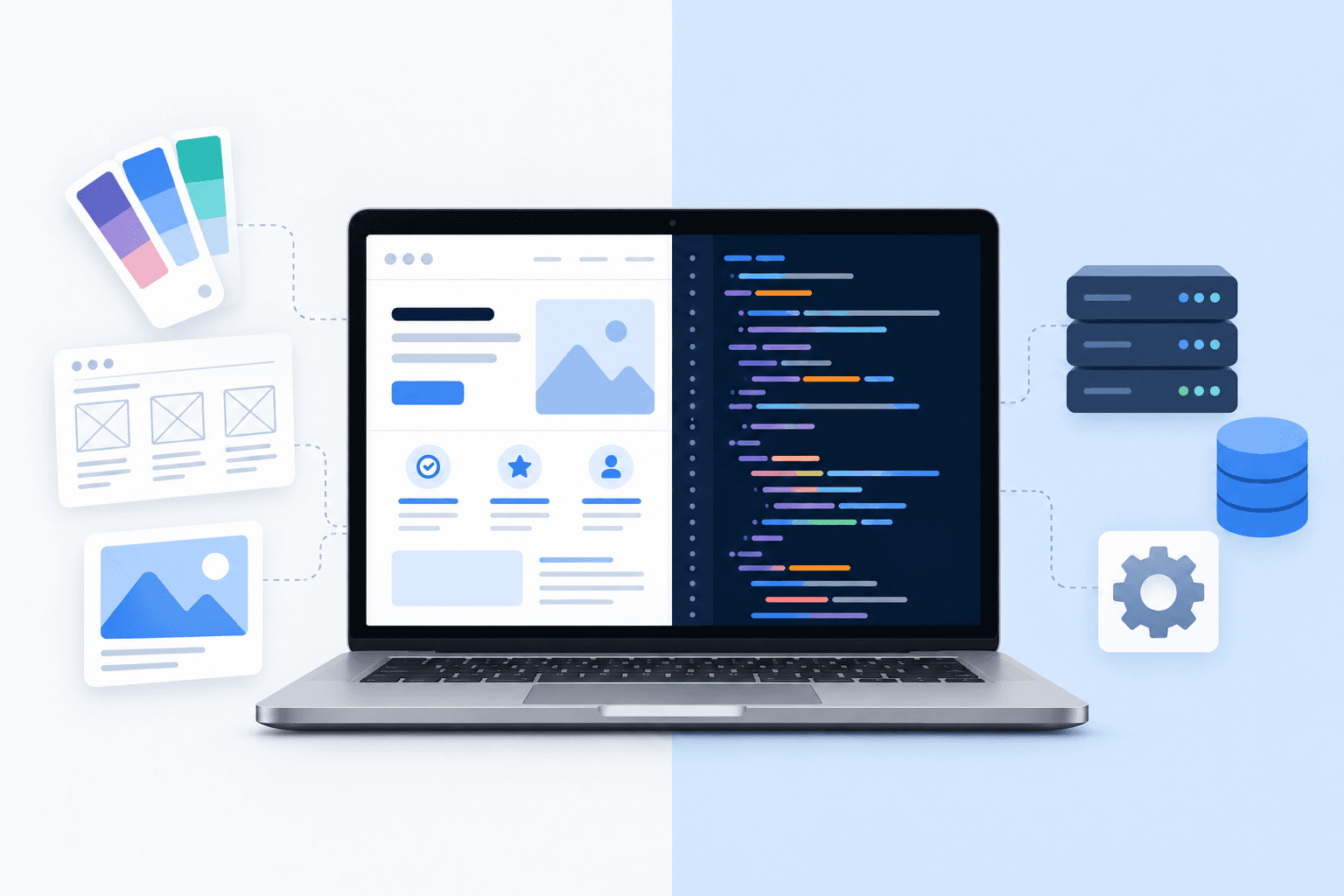
Website design defines the visual direction, page layouts, and user experience before the website is built. Website development takes those approved designs and turns them into a functioning website.
You do not need to understand programming or the technical details of WordPress to hire a web company. But understanding the difference between design and development can help you evaluate a company more effectively and ask better questions before your new website is built.
What Does Website Design Cover?
Website design is more than choosing colors or making a website look attractive.
For most business websites, the design process should be collaborative. The business owner or internal team provides direction on the company, customers, priorities, content, and overall goals. The designer uses that direction to create visual concepts and page mockups that show how the finished website should look and how the information should be presented.
Website design typically includes:
- Page layouts
- Navigation concepts
- Visual hierarchy
- Typography, colors, and imagery
- Branding
- Placement of calls to action
- Organization of information
- Responsive design considerations
At OC Websites, our designers create the approved page designs in Figma. They are defining the visual direction and user-facing experience of the website, not building the website itself.
Once the designs are approved, they are handed to the development team for implementation.
What Does Website Development Cover?
Website development takes the design and business requirements and turns them into an actual working website.
Writing code can be part of website development, but development involves considerably more than programming. On a WordPress website, the developer may be responsible for:
- Building the pages and reusable website components
- Structuring the website within WordPress
- Configuring forms and other functionality
- Implementing ecommerce features
- Connecting third-party services
- Making the website work properly across devices
- Determining how content will be managed
- Addressing website performance
- Adding custom functionality when necessary
- Testing and troubleshooting the completed website
The developer is not simply trying to reproduce what the designer created on a screen. The developer also has to determine the appropriate way to build it.
That distinction becomes important once the website is being used by a real business.
Designers and Developers Look at a Website Differently
Website designers and developers approach the same project from different perspectives.
Design is generally more creative and communication-oriented. A designer is thinking about what the visitor should see, how information should be presented, how the pages should flow, and how the finished website should represent the business visually.
Development is more analytical and technical. A developer takes the approved designs and determines the best way to build them within WordPress while also considering structure, functionality, performance, maintainability, and future changes.
Neither perspective is more important. They solve different problems.
The distinction matters because reproducing an approved design is only part of the developer’s job. The developer also has to determine how that design should be implemented technically.
A website can match the approved design perfectly and still be poorly developed if the underlying structure is unnecessarily complicated, inefficient, or difficult to maintain.
Where Website Design and Development Come Together
The handoff between design and development is where the two disciplines come together.
The designer establishes how the website should look and how information should be presented. The developer then takes those approved mockups and turns them into a functioning WordPress website.
For example, a designer may create a contact page mockup showing the form layout, field placement, and visual treatment. The developer builds the actual form, configures validation and notifications, and connects it with other systems when necessary.
For an ecommerce website, the designer may create mockups showing how products, categories, pricing, and purchasing options should appear. The developer builds the WooCommerce structure and makes the products, variations, cart, checkout, payments, shipping, and other functionality work properly.
Even a standard service page follows the same process. The designer establishes the approved page layout in Figma. The developer builds the WordPress components needed to reproduce that layout consistently across the website.
The design provides the visual direction. Development turns the approved design into a functioning website.
Why the Difference Matters More on Larger Websites
Not every business website requires the same amount of development.
A smaller informational website with relatively straightforward pages and functionality may not require a large development team or highly specialized technical work.
As a website becomes larger or more complex, however, development decisions become increasingly important.
A larger site might include:
- Many different types of pages
- Ecommerce
- Large product or service catalogs
- Multiple locations
- Specialized forms
- Customer accounts
- Third-party integrations
- Custom functionality
- Multiple employees managing website content
- Requirements for future expansion
With more moving parts, consistency and technical structure become more important. A development decision that affects one page on a small website may eventually affect hundreds of pages, products, or pieces of content on a larger one.
This is where having someone specifically focused on the technical side of the website becomes particularly valuable.
Can the Same Person Be Both a Designer and a Developer?
Yes, particularly on smaller websites.
Website design and website development are different disciplines, but that does not mean they must always be handled by different people.
Some web professionals have enough experience in both areas to create the design and build the website themselves.
As websites become larger or more complex, specialization becomes more valuable. The designer can concentrate on visual communication, page layouts, usability, and the overall user experience while the developer concentrates on how the approved designs should be implemented technically.
For larger projects, this often means separate design and development responsibilities working together on the same custom website project.
For the business owner, the important question is not how many people are involved. It is whether both the design and development responsibilities are being handled properly.
Why This Matters With WordPress
WordPress makes it possible to build a wide variety of business websites, from relatively simple informational sites to large ecommerce and custom websites.
That flexibility is one of its strengths. It also means there can be many different ways to build the same website.
Two WordPress websites can look nearly identical to a visitor while being structured very differently behind the scenes.
A developer has to make decisions about how WordPress will be configured, what functionality should be built with existing features or plugins, when custom development makes sense, how content should be structured, and how the different pieces of the website should work together.
Some projects also require custom website development for functionality, integrations, or features that go beyond a standard WordPress build.
WordPress provides the tools. Website development determines how those tools are used.
For a business owner, the goal is not to dictate those technical choices. It is to work with a company that can make those decisions thoughtfully and explain its approach in understandable terms.
5 Questions to Ask About Website Development Before Hiring a Web Company
You do not need to conduct a technical interview with a prospective web company. A few straightforward questions can tell you quite a bit about how they approach both design and development. The same principle applies when comparing website proposals: understanding what is actually included is more useful than comparing price alone.
1. Who will handle the website design and who will handle the development?
The answer may be one person, several people, or different members of a team. What matters is that the company recognizes these as separate responsibilities and has the appropriate skills to handle both.
2. Will our website be built using a theme, template, page builder, or custom development?
There is nothing inherently wrong with any of these approaches. Most WordPress websites use some combination of existing tools and custom development.
What matters is understanding how the company plans to build your website and whether that approach is appropriate for the size, functionality, and requirements of the project. Websites that look similar on the surface can be built very differently behind the scenes, which we explain in The Difference Between a Custom Website and a Modified Template.
3. How do you decide when to use standard WordPress functionality, plugins, or custom development?
There is no single correct answer.
Sometimes an established plugin is the most practical solution. Other situations may justify custom development. The important point is that these choices should be based on the requirements of the website rather than simply using whatever is fastest or most familiar.
4. Will our staff be able to make normal website updates after launch?
For most business websites, employees should be able to handle reasonable content changes without needing a developer for every small update.
Ask the company what you will be able to edit and how the website will be managed after launch. This also gives you some insight into how much thought has been given to the administrative side of the website.
5. How do you test the website before it goes live?
A website should not simply be reviewed to make sure it looks like the approved design.
Testing should also consider important functionality, forms, links, different screen sizes, common browsers, website performance, and other requirements specific to the project.
The answer does not need to be complicated. There should simply be a process.
You Don’t Need to Be a Website Developer to Ask the Right Questions
Most business owners have no reason to become experts in website development. That is what they are hiring a web company to handle.
It is useful, however, to recognize that website design and website development are not interchangeable terms.
A new business website needs the creative thinking required to communicate clearly and provide a good user experience. It also needs the technical thinking required to turn that design into a functioning website that can be managed, maintained, and expanded when necessary.
Sometimes one person can provide both. On larger projects, different specialists may be involved.
What matters is that neither side of the project is overlooked.
Understanding that distinction gives you a better way to evaluate a web company before hiring them—and a better understanding of what you are actually paying for when your new website is built.